 Join The Club





A dream shared by PC gamers everywhere has been to take our entire gaming PCs on the go. From LAN parties to powerful gaming laptops, we've gotten close to portable gaming nirvana, yet no solution is quite as simple as pulling out one of the latest generation of PC gaming handhelds and gaming from near enough anywhere.
We've tested most of today's top gaming handhelds and come away impressed with many of them. However, there are a few that stand head and shoulders above the crowd. The best handheld gaming PC is the Lenovo Legion Go S SteamOS, with a big 8-inch screen, comfy grips, and Valve's lightweight, gaming-oriented OS to boot.
The best budget handheld gaming PC is the Steam Deck, another SteamOS handheld and one with all the right credentials for less than most of the competition. If a SteamOS handheld isn't your jam, though, the ROG Xbox Ally X is the best Windows handheld out there right now. Don't be fooled by the 'this is an Xbox' branding—underneath lies a remarkably quick and surprisingly comfortable portable gaming PC.
The quick list

The best overall
This handheld combines some serious hardware with SteamOS, which means great performance and efficiency plus all the ease of use of Valve's OS. Oh, and the handheld itself is really lovely to hold and use, too.

The best budget
The Steam Deck is unbeatable in one very important way: it's far cheaper than most of the competition. It's definitely the best value option, and it's a neat gaming device for the money.

The best Windows
This is an Xbox, says Microsoft. Nope, it's an excellent handheld gaming PC says us, as it's incredibly comfortable, quiet, and has the best gaming performance of any handheld we've tested to date. It's seriously pricey, though.

The best big screen
The Lenovo Legion Go has a huge 8.8-inch screen, although you'll want to turn down the resolution a tad for the best performance. It also features detachable controllers that really make it stand out.

The best compact
This handheld is not only compact and portable, but also incredibly usable and versatile. Its dual-screen setup allows for super-easy desktop navigation.

Gaming handhelds haven't been around for long, which means Jacob has had a chance to experience many of them first-hand. From Alienware's short-lived Project UFO and pre-Steam Deck Intel-powered handhelds, which left a lot to be desired, to the wave of modern and extremely adept handhelds we're seeing today—Jacob has tried the lot.
October 29, 2025: We've added the Asus ROG Xbox Ally X in as our best Windows handheld pick, as it's a very impressive machine. It's a comfortable, quiet, and extremely quick gaming handheld, although it's also expensive enough to prevent it from taking the top spot overall. Still, it's undoubtedly a handheld well worth considering if you've got the cash to flash. We've also had a tidy up of this guide overall, and pushed the MSI Claw 8 AI+ down to the Also Tested section, as the ROG Xbox Ally X has somewhat eaten its lunch.
July 2, 2025: Added the Lenovo Legion Go S SteamOS as the best handheld gaming PC, in place of the Asus ROG Ally X which now sits in our Also Tested section. The Legion Go S SteamOS brings Valve's lightweight gaming OS to a handheld with some serious hardware, resulting in a handheld that keeps up with the best-performing ones out there, costs less, and offers all the benefits of the gaming-oriented operating system. The MSI Claw 8 AI+ is a good alternative if you want the extra game and app compatibility Windows offers, though, so we've labelled that the best Windows handheld gaming PC.
May 15, 2025: We have added the Ayaneo 3 gaming handheld to the also tested section. Though it's a pretty clever little modular device with a good Ryzen chip, it is let down by software, and the modular parts feel like they could actually break. We have also checked over our current recommendations, comparing them to the rest of the market to ensure we are endorsing the best handhelds out there.
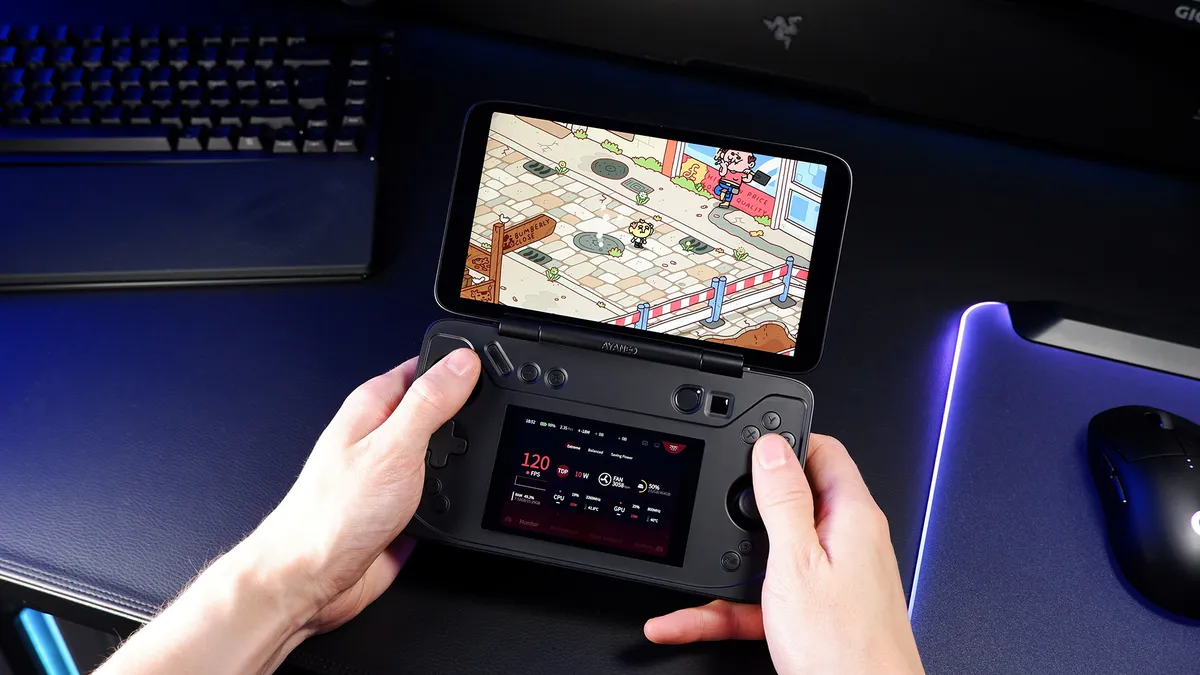


✅ You want true portability: It's not only small, but also safer to throw in a backpack, given the screens and controls are somewhat protected when closed.
✅ You want super-easy navigation: Its dual-screen design allows for clever trackpad and keyboard solutions to the usual handheld navigation woes.
❌ You want the best battery life: The Flip DS doesn't have bad battery life, but it's not the best. The ROG Ally X, for example, does better on this front.
❌ You want the best performance for money: You're paying extra for the incredibly useful design, here, but this means you sacrifice a little performance for the money. If it's pure value for specifications that you want, there are better options.
The Ayaneo Flip DS is the best compact handheld gaming PC, in part because it shows there's more to portability than simply being small. It's relatively tiny, without a doubt, but what also makes it incredibly portable is that it's easy to carry around with less risk of damaging the screen or controls.
That's because it's a dual-screener (thus the "DS", like the Nintendo DS) that closes shut. And while this dual-screen design makes it easily portable, it also makes it just about the most useful, easily navigable handheld I've tried.
While its 7-inch, 120 Hz, 1080p upper screen—which is surprisingly big for such a small handheld—works its magic reproducing rendered game frames in pleasing fashion, the dinkier 3.5-inch lower screen is freed up to be used as a keyboard, touchpad, or whatever you like. It's particularly useful to use it for the Ayaneo Space system application to configure and keep an eye on how your handheld's chugging along.
And chug along it does, just as much as any other reasonable handheld these days, anyway, thanks to its Ryzen 7 8840U APU with RDNA 3 graphics. You're getting the standard handheld gaming PC performance here: nothing to write home about, but it holds its own against all the mainstream options and is plenty for most handheld gaming needs. Battery life is decent, too, although you'll get more life out of something like the Lenovo Legion Go S.
The main reason to opt for the Flip DS, though, is for that DS functionality. We're not just talking when in-game, either. It makes Windows navigation so much easier, too, whether you're using the smaller screen as a trackpad, a keyboard for easily entering passwords, or a more traditional second screen to house applications you need visible while tootling around the desktop on the top screen.
Navigation and ease of use really is the name of the game here. It even has a little nubbin that you rub to move the mouse in any direction and click to press LMB. Oh, plus the ability to slow or speed up your cursor movement with left- and right-trigger modifiers. It's surprisingly simple to get used to all these different navigation methods and combine them for ultimate ease of use.
The Ayaneo Flip DS demonstrates the exact kind of innovation that's needed in the handheld market. It's not all about churning out more frames per second. Sometimes it's nice to have substantial upgrades in other ways, such as navigation functionality, compactness, and portability. The Flip DS delivers on all these fronts.
Read our full Ayaneo Flip DS review.
Also tested
How we test handheld gaming PCs
When we test handheld gaming PCs, we live with them in the same way you would at home, using them to play the latest big-budget games and any indie titles that take our fancy.
This will highlight any failings in battery life, how the screen looks long-term, and how the thumbsticks feel after hours of play. Each device is calibrated to play as it should, and compatible games are tested at multiple different settings.
Fast-paced shooters are perfect for testing the response of the screen, and the neon-dripping world of Cyberpunk 2077 makes for an excellent HDR tester. We try to cover a good range of gaming use cases.
We also go through a series of experiential tests to highlight any performance problems, as well as assess heating over the long term and how upgradable things like the internal storage are. It can be easy to get lost in a sea of numbers, so, as well as doing specific tests, we make sure we get lots of time in every day, as we would with a traditional gaming rig.
Given they are handheld gaming PCs, the feel is incredibly important, so we make sure to test lots of different types of games to find each device's strong and weak points.
Best handheld gaming PC FAQ
What is the most powerful handheld gaming PC
As of right now, the ROG Xbox Ally X is the fastest handheld we've tested to date in terms of real world gaming performance. However, any AMD HX 370-powered device you see will also be very quick, and Lunar Lake handhelds such as the MSI Claw 8 AI+ aren't far off.
What CPU should you look for in a handheld gaming PC?
The best commercial CPUs for handheld Gaming PCs right now are the AMD Ryzen Z2 Extreme, the AMD Ryzen AI 9 HX 370 or the Intel Core Ultra 7 258V (there might be other Core Ultra 200V processors in handhelds down the line). Previous-gen ones are still very strong choices, though, especially if you can pick them up for cheap: the Ryzen 7 8840U and Ryzen Z1 Extreme are still powerful handheld processors.
How much RAM do you need in a handheld gaming PC?
16 GB of memory should be the minimum amount of RAM you look for in a handheld gaming PC. This is because handheld memory counts for both system memory and the GPU's VRAM—two portions of memory which are usually separate in desktops and gaming laptops. A few GB will ideally be used as VRAM, so if you have 24 GB of memory, that'll still leave 16+ GB for your system to use, with up to 8 GB used as VRAM for the GPU. 16 GB is fine, though, especially if the handheld's only using, say, 4 GB of that for the GPU.
How much storage should you get in a handheld gaming PC?
Though bigger is better, and this is especially true when you can often upgrade storage, the sweet spot for commercial handheld gaming PCs right now tends to be at around 1 TB. This gives plenty of room for both big-budget titles and smaller indie games.